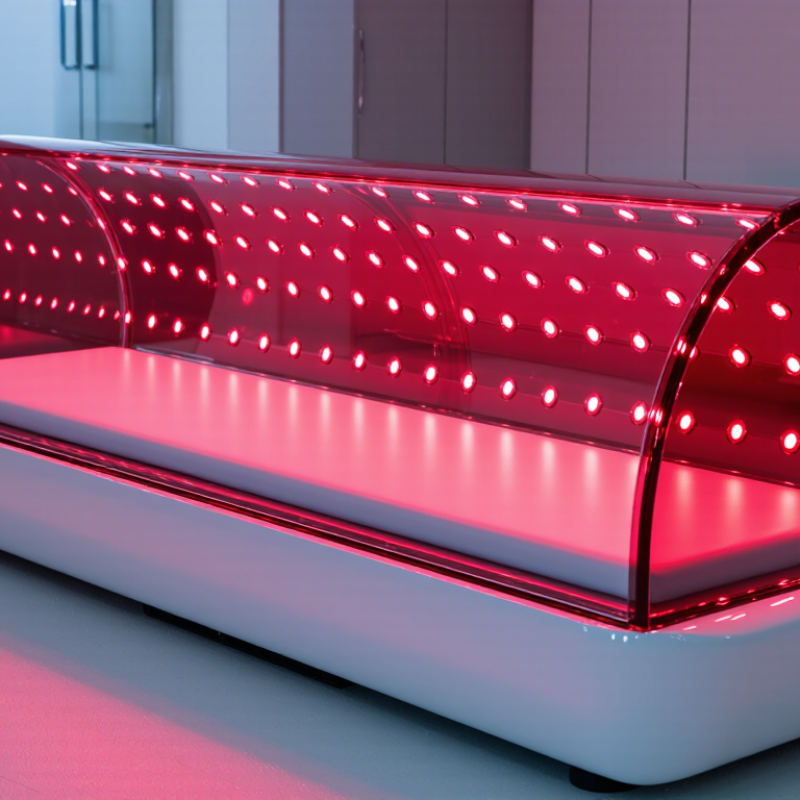
A Red Light Therapy Bed is a full-body device that uses low-intensity red and near-infrared LEDs. It is designed to expose the skin to specific light wavelengths without ultraviolet radiation. Unlike a tanning bed, it should not darken the skin.
The concept comes from photobiomodulation, a field studied in clinical and laboratory settings. Dr. Michael R. Hamblin, a leading photobiomodulation researcher, has described it as “the use of light to stimulate healing.” This simple phrase captures the basic idea, but the science is more complex. Light energy may interact with cellular processes, including mitochondrial activity and inflammatory responses. Results can depend on wavelength, treatment time, device quality, and individual health conditions.
Some users report warmer skin, temporary redness, or a relaxed feeling after treatment. Others notice little change. That difference matters. A Red Light Therapy Bed is not a universal solution, and marketing claims can sound more certain than the evidence allows. Professional guidance remains sensible, especially for people using photosensitizing medication or managing a medical condition.
The bed itself may resemble a standing booth or a horizontal wellness platform. Its panels usually contain many LEDs, creating an even glow across the body. Comfort is common, but comfort does not prove effectiveness. A careful explanation should separate personal experience from established research. That distinction helps readers understand what this technology may offer, what remains uncertain, and how to evaluate a device responsibly.
What Is a Red Light Therapy Bed?
A red light therapy bed is a full-body device using red and near-infrared LEDs. It is designed for photobiomodulation, not tanning. Common wavelengths include approximately 630–660 nanometres and 810–850 nanometres. These wavelengths may reach skin tissue and support cellular energy processes. The proposed mechanism involves mitochondrial activity and increased adenosine triphosphate production. In practical terms, a session feels like gentle warmth across your back, legs, and shoulders.
No ultraviolet radiation is the defining difference. The International Agency for Research on Cancer classifies ultraviolet tanning devices as Group 1 carcinogens. A red light bed does not create a tan through UV exposure. It should not be marketed as a replacement for medical treatment. Evidence remains stronger for some skin and pain applications than for broad wellness claims. The category is not perfectly standardized. Output power, treatment distance, exposure time, and wavelength can vary considerably.
Interest is growing within the wider wellness economy. The Global Wellness Institute’s 2024 Wellness Economy Monitor valued that economy at 6.3 trillion dollars in 2023. However, market growth does not prove clinical effectiveness. Users should check irradiance data, safety instructions, and realistic treatment goals. Eye protection may be appropriate, especially with high-intensity devices. People using photosensitising medication should ask a qualified clinician first. Results can also be subtle. That part is often overlooked.

A red light therapy bed is a full-body photobiomodulation device that uses non-UV red and near-infrared light rather than ultraviolet radiation used for tanning. The chart shows representative wavelengths commonly used in photobiomodulation systems.
Red light is commonly associated with wavelengths around 630–660 nm, while near-infrared light is commonly positioned around 810–850 nm. These wavelengths are presented as examples of light settings, not as a comparison of treatment effectiveness.
What Is a Red Light Therapy Bed?
A red light therapy bed uses low-intensity LEDs to expose much of the body to specific light wavelengths. The most discussed range is red light at 630–660 nm. It mainly targets superficial tissue, where users may notice warmth or mild redness. Near-infrared light, commonly 810–850 nm, travels deeper and is often selected for muscles and joints. Penetration is not a fixed number. Skin thickness, body composition, distance, and device output all change the result.
Professional photobiomodulation guidance from the World Association for Photobiomodulation Therapy commonly uses fluence ranges near 4–10 J/cm² for selected protocols. Many research devices also operate around 10–50 mW/cm². These figures are reference points, not universal prescriptions. A 2023 review in Photobiomodulation, Photomedicine, and Laser Surgery found that outcomes varied significantly with wavelength, dose, treatment timing, and study quality. That matters. More light is not automatically better.
Tips: Check the measured irradiance, not only the advertised wavelength. Follow the session time provided by the manufacturer. Protect your eyes when instructions require it. Start conservatively, especially with sensitive skin or photosensitizing medication. Keep a simple log of distance, exposure time, and skin response. Results may be subtle. Reflection is useful, because personal experience can mislead without consistent records.
| Data Dimension | Red Light: 630–660 nm | Near-Infrared Light: 810–850 nm |
|---|---|---|
| What it is | Visible red light used in low-level photobiomodulation applications. | Longer-wavelength, invisible light commonly used to reach deeper tissues than visible red light. |
| Typical wavelength range | 630–660 nanometers (nm) | 810–850 nanometers (nm) |
| Visibility | Visible to the human eye as red light. | Generally invisible to the human eye. |
| Primary tissue target | Primarily the skin and superficial tissues, with penetration influenced by wavelength, skin properties, and device output. | Typically selected when light exposure to deeper soft tissues is desired; actual depth varies with tissue and treatment parameters. |
| Commonly studied applications | Support for selected skin-related goals, such as appearance of fine lines, texture, and wound-healing research. | Research involving muscle recovery, joint comfort, circulation-related responses, and other deeper-tissue applications. |
| How a therapy bed uses it | Multiple light-emitting modules distribute red light over a large portion of the body. | Near-infrared modules may be combined with red-light modules to provide broader wavelength coverage. |
| Measurement that matters | Irradiance, measured in milliwatts per square centimeter (mW/cm²), and treatment time. | Irradiance at the body surface, treatment time, and the delivered energy dose. |
| Dose calculation | Energy density (J/cm²) = irradiance (W/cm²) × time (seconds). | Energy density (J/cm²) = irradiance (W/cm²) × time (seconds); the same calculation applies to near-infrared light. |
| Thermal effect | Designed for low-level light exposure rather than intentional tanning; mild warmth may still occur. | May produce warmth depending on irradiance, distance, session length, ventilation, and device design. |
| Key advantages of a full-body bed | Large-area exposure can be more convenient than treating small areas separately. | A broad treatment area can expose several body regions during one session. |
| What it does not provide | It does not provide ultraviolet tanning light when the device is designed without UV wavelengths. | It should not be assumed to treat a medical condition or replace professional medical care. |
| Important safety considerations | Follow the device instructions, avoid staring into bright LEDs, and use recommended eye protection when specified. | Consult a qualified healthcare professional if using photosensitizing medication, managing an eye condition, or treating a medical problem. |
A red light therapy bed uses low-level red or near-infrared light across a large part of the body. Its performance depends on two measurements: irradiance and fluence. Irradiance describes power delivered to each square centimetre, measured in mW/cm². Fluence describes the total energy delivered, measured in J/cm².
A bed may provide about 10–100 mW/cm² and deliver 4–60 J/cm². These numbers are not interchangeable. Treatment time links them together.
For example, 10 mW/cm² equals 0.01 W/cm², so reaching 4 J/cm² takes roughly 400 seconds. At 100 mW/cm², the same fluence takes about 40 seconds.
Higher output shortens sessions, but more energy is not automatically better. Distance, body position, exposed skin, and calibration can change the actual dose. Manufacturer figures may also describe peak output, not average output.
Tips: Check whether the stated irradiance was measured at the treatment surface. Follow the recommended session time and use eye protection when instructed. Keep notes on duration, skin response, and comfort. Mild warmth can occur, but pain or persistent redness deserves attention. A qualified healthcare professional can help assess suitability, especially with photosensitive conditions or medications.
The calculation looks simple. Real-world dosing is less tidy. Even careful users may assume a uniform light field, although beds can produce brighter and weaker zones. That limitation should shape expectations. Evidence also varies by condition, so avoid treating a wellness session as a guaranteed medical solution.
A red light therapy bed uses LED panels to deliver red and near-infrared light across the body. The LEDs are the working core, but wavelength and irradiance matter more than appearance. Common systems use visible red light around 630–660 nanometers and near-infrared light around 810–850 nanometers. These ranges are widely discussed in photobiomodulation research, although results depend on dose, distance, and treatment time. A 2023 systematic review in Photobiomodulation, Photomedicine, and Laser Surgery noted that inconsistent device settings make comparisons difficult.
Coverage shapes the experience. Full-body beds may place LEDs above and below the user, reducing shaded areas. A small panel can leave the legs or sides underexposed. That detail is easy to miss. The Global Wellness Institute reported that the global wellness economy reached approximately $6.3 trillion in 2023, increasing interest in home and professional light-based services. Market growth, however, does not prove equal clinical performance.
Timers should control exposure consistently, while cooling systems protect LED output and user comfort. Fans, vents, and temperature sensors can prevent heat buildup during longer sessions. IEC 62471 provides a recognized framework for evaluating photobiological safety, but users should still follow the device’s tested instructions. More power is not automatically better. I would check measured irradiance, tested wavelengths, ventilation, and eye-protection guidance before comparing prices. Some specifications remain incomplete, and that deserves careful questioning.
A red light therapy bed uses panels of visible red and near-infrared light across the body. Its warmth may feel gentle, but comfort does not prove safety. IEC 62471 evaluates photobiological hazards, including eye and skin exposure. Devices receive risk groups from Exempt to RG3, based on wavelength, irradiance, distance, and exposure time. A lower risk group is reassuring, not a promise of zero risk.
FDA clearance applies to a specific device and intended use. It does not validate every marketing claim or guarantee results for every person. Clinical research suggests possible benefits for selected skin concerns, pain, or recovery, but study sizes and treatment schedules vary. Evidence remains uneven. I would question confident promises of rapid healing or permanent changes. The clinical limit is important: a therapy bed cannot replace diagnosis, prescribed treatment, or professional monitoring.
Tips: Ask for the IEC 62471 risk-group classification and measured irradiance. Follow the stated session time, rather than assuming longer exposure works better. Use eye protection when required. Discuss treatment with a clinician if you take photosensitizing medicine or have an eye condition. Stop if you notice persistent redness, pain, blurred vision, or unusual skin changes. Keep records of session length and symptoms; small details can reveal whether the treatment is helping or simply becoming a habit.
© Shipham Valves 2025. All Rights Reserved.
Website By PS Website Design Ltd
Request a Quote/Further Information
Download
We use cookies on this website, by continuing to browse the site you are agreeing to our use of cookies. Find out more.