What is Ntc Thermistor Function and Its Applications?
In the realm of electronic components, NTC thermistors play a pivotal role. Their function, which relies on a decrease in resistance with rising temperature, makes them essential for temperature sensing and control applications. According to the latest market research by Technavio, the global NTC thermistor market is projected to reach $1.5 billion by 2026, showcasing a compound annual growth rate (CAGR) of 6.3%. This growth signifies the increasing importance of Ntc Thermistor Function in various industries.
Experts like Dr. Emily Tran, a leading figure in thermistor technology, emphasize the significance of these components. “NTC thermistors are fundamental in improving efficiency and reliability in electronic systems,” she notes. Their applications span automotive, medical equipment, and consumer electronics, highlighting their versatility. Despite their advantages, NTC thermistors have limitations. For example, their non-linear response can complicate temperature readings, requiring careful calibration.
The demand for precise temperature monitoring is rising, and NTC thermistors are central to this evolution. As industries aim for sustainability and efficiency, understanding NTC thermistor function becomes crucial. With the right insights, we can navigate the complexities of thermistor applications and optimize their use for future advancements.
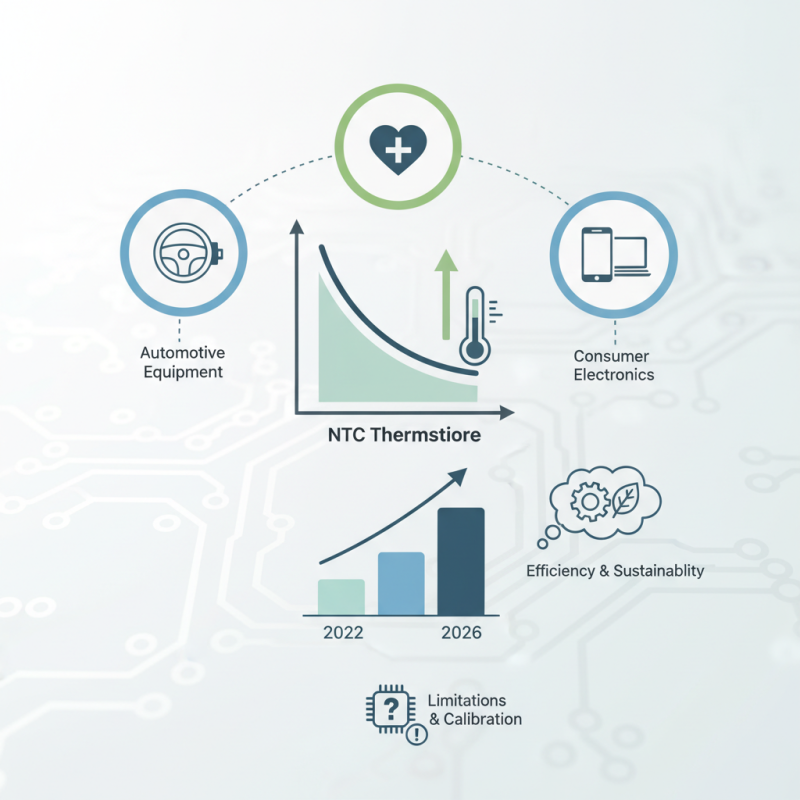
What is an NTC Thermistor?
NTC thermistors, or Negative Temperature Coefficient thermistors, are crucial components in temperature sensing and control. These resistive devices exhibit a decrease in resistance as temperature increases. This unique property is exploited in various applications, from temperature probes in HVAC systems to safety devices in automotive industries. According to market reports, the global thermistor market is expected to reach $4 billion by 2025, driven by rising demand for accurate temperature measurement.
One significant application of NTC thermistors is in electronic circuit protection. They are used to limit inrush current during power-up in circuits, reducing the risk of damage. Notably, the precision of NTC thermistors makes them ideal for digital thermometers and medical devices. They can achieve an accuracy of ±0.1°C, enhancing reliability in critical measurements. This capability is vital in scenarios where temperature assessment affects health and safety.
Tips: When selecting an NTC thermistor, pay attention to its resistance value at a specific temperature. This detail influences the accuracy of your application. Additionally, consider the thermal time constant, which affects how quickly the thermistor responds to temperature changes. In a world of diverse applications, understanding these aspects will help streamline your choices and improve your designs. Remember, even minor miscalculations in resistance could lead to significant operational challenges. Always validate your selections with proper testing.
How NTC Thermistors Work: Principles and Mechanisms
NTC thermistors, or negative temperature coefficient thermistors, are fascinating components in electronic circuits. They significantly change resistance in response to temperature variations. As the temperature rises, their resistance decreases. This property makes them essential for precise temperature monitoring and control in various applications.
Understanding their working principle is crucial. NTC thermistors are made from semiconductor materials. These materials exhibit a remarkable change in resistance based on temperature fluctuations. When heat is applied, more charge carriers become available, leading to lower resistance. This behavior allows these thermistors to act as temperature sensors, triggering alarms or regulating power in devices.
In practical applications, NTC thermistors are widely used in power supplies, automotive systems, and home appliances. They help protect circuits from overheating and ensure stable operation under varying conditions. However, they can sometimes be sensitive to rapid temperature changes. This sensitivity can lead to inaccurate readings if not properly calibrated. Balancing response time and accuracy is a key challenge in utilizing these thermistors effectively.
Common Applications of NTC Thermistors in Industry
NTC thermistors, known for their negative temperature coefficient properties, play crucial roles across various industries. These devices exhibit a significant decrease in resistance as temperature rises, making them ideal for temperature sensing and control applications. By monitoring temperature changes, NTC thermistors can enhance system efficiency and ensure safety in numerous settings.
In the automotive sector, for instance, NTC thermistors are vital for monitoring engine temperatures. They help in optimizing fuel efficiency and safeguarding engine performance. According to a report by Markets and Markets, the global automotive sensors market is projected to reach $43.5 billion by 2025, with NTC thermistors contributing significantly to this growth. Their accuracy in providing real-time data is invaluable for modern engine management systems.
Additionally, NTC thermistors are widely used in consumer electronics. In devices like refrigerators and air conditioners, they aid in maintaining optimal operating temperatures. A report from Allied Market Research states that the global HVAC market is expected to grow to $240 billion by 2027. These sensors help optimize energy consumption, which is a significant advantage.
Tip: When switching to NTC thermistors, ensure proper calibration to match the required temperature range. This helps avoid inaccuracies that could lead to equipment malfunction. Considering the application environment is essential for effective performance.
Benefits of Using NTC Thermistors in Temperature Sensing
NTC thermistors are crucial in temperature sensing applications. They offer significant benefits that enhance performance and accuracy. NTC thermistors have a negative temperature coefficient, meaning their resistance decreases as temperature increases. This characteristic enables precise temperature readings in various environments. Many industries rely on these sensors for monitoring purposes.
According to a recent report from Allied Market Research, the global thermistor market is projected to reach $1.4 billion by 2026. This growth indicates the increasing dependency on thermistors in sectors like automotive and healthcare. NTC thermistors are favored due to their sensitivity and rapid response times. This makes them ideal for battery management systems and climate control devices.
Tip: When selecting an NTC thermistor, consider its resistance range and thermal time constant. These factors influence accuracy and response speed. A mismatch could lead to inaccurate readings, which may compromise safety. Understanding the operating conditions is essential for optimal performance.
NTC thermistors also provide cost-effective solutions for temperature sensing. They are lower in price compared to some alternatives. However, they are not perfect. They can be sensitive to electrical noise, impacting accuracy in fluctuating environments. Careful design and installation are necessary to mitigate these issues, ensuring reliable temperature sensing in critical applications.
Challenges and Limitations of NTC Thermistors in Practice
NTC thermistors play a crucial role in various applications, especially in temperature sensing. However, their implementation comes with significant challenges and limitations. One major issue is their non-linearity in resistance-temperature characteristics. This makes precise temperature measurement difficult over a broad range. In high-accuracy situations, even small deviations can lead to errors.
Another limitation involves response time. NTC thermistors may be slow to react to rapid temperature changes. This is problematic in systems requiring immediate feedback. Moreover, they can exhibit sensitivity to mechanical stress and humidity, which can alter their performance. These factors undermine their reliability in critical applications.
Calibration processes can also be cumbersome. Continuous recalibration is often necessary to ensure accuracy. In practice, this adds complexity and potential for human error. Users must be aware of these challenges when choosing NTC thermistors for specific uses. Their advantages should be weighed against these inherent limitations.