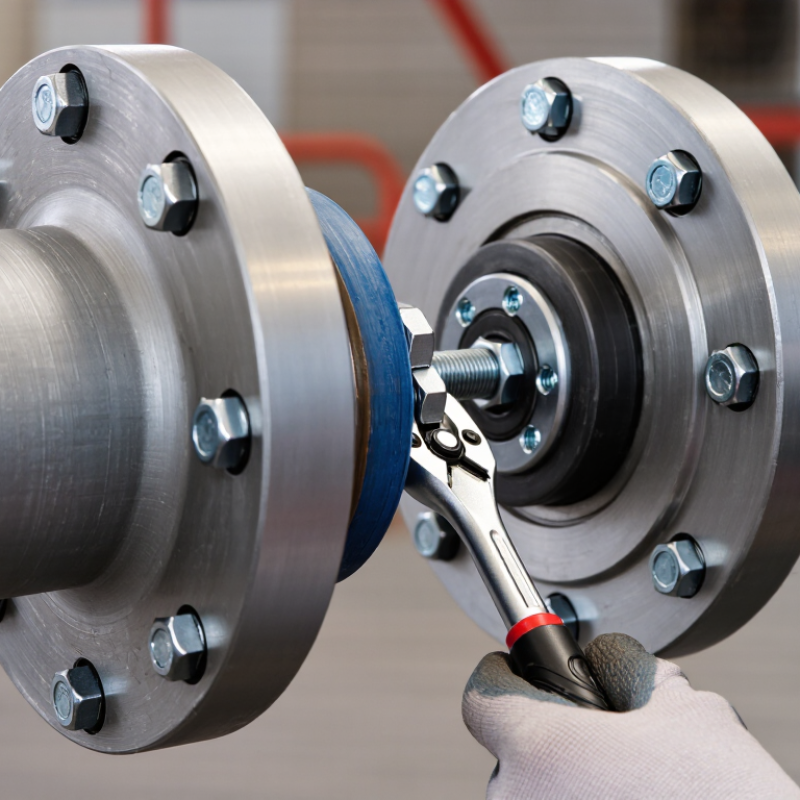
| Basic Definition | A bolted mechanical joint used to connect pipes, valves, pumps, vessels, or other equipment. | The flange creates a detachable connection by using two facing surfaces, a gasket, and evenly tightened bolts or studs. |
| Primary Components | Two flange faces, one gasket, bolts or studs, and nuts. | Each component has a specific role: the flange faces provide support, the gasket seals the interface, and the fasteners generate the clamping force needed to maintain contact. |
| Connection Principle | Controlled bolt preload compresses the gasket between the flange faces. | The compressed gasket fills small surface irregularities and blocks the escape of liquid or gas through the joint. |
| Common Flange Types | Examples
Weld-neck, slip-on, socket-weld, threaded, lap-joint, and blind flanges. | The suitable type depends on pipe size, pressure, temperature, installation method, alignment requirements, and whether the line must be closed or periodically dismantled. |
| Flange Face Styles | Flat face, raised face, and ring-type joint face. | Face geometry controls how the gasket is positioned and compressed. The mating faces and gasket must be compatible to achieve reliable sealing. |
| Gasket Function | A replaceable sealing element made from a material suitable for the service conditions. | Gasket selection must consider fluid compatibility, operating temperature, pressure, flange-face condition, and the required level of leak resistance. |
| Fastener Function | Bolts or studs apply and retain the required clamping force. | Correct fastener grade, length, lubrication practice, and tightening sequence help distribute compression evenly and reduce the risk of leakage or flange distortion. |
| Tightening Method | Cross-pattern tightening in multiple stages, using a calibrated torque tool when specified. | A staged, alternating sequence reduces uneven loading and helps maintain uniform gasket compression around the entire circumference. |
| Pressure Capability | Determined by the applicable piping standard, flange rating, material, temperature, size, gasket, and fasteners. | A pressure class or rating cannot be selected from flange size alone. The complete joint must be evaluated for the intended operating and design conditions. |
| Temperature Considerations | The allowable rating may decrease as operating temperature increases. | Heat can reduce material strength, change bolt preload, and affect gasket resilience. Thermal expansion may also impose additional loads on the joint. |
| Load Resistance | Resists internal pressure and transfers mechanical loads through the flange, bolts, gasket, and connected piping. | The joint must also account for bending, vibration, pipe weight, thermal movement, and external forces so that the gasket is not overloaded or unloaded. |
| Installation Sequence | Inspect, align, clean, position the gasket, install fasteners, tighten progressively, and verify the joint. | Proper preparation prevents damaged sealing surfaces, gasket misalignment, cross-threading, and uneven compression before the system is placed in service. |
| Alignment Requirement | Flange faces should be parallel, properly centered, and free from forced misalignment. | Using bolts to pull misaligned piping into position can create excessive stress, uneven gasket loading, and premature leakage. |
| Inspection Points | Check flange-face condition, gasket placement, bolt condition, thread engagement, tightening sequence, and visible gaps. | Inspection identifies installation defects that could compromise sealing before pressure testing or operation. |
| Leak Testing | Hydrostatic, pneumatic, or other approved testing methods may be used according to the governing procedure. | Testing verifies joint integrity under controlled conditions. Pneumatic testing requires additional safety precautions because compressed gas stores significant energy. |
| Main Advantages | Detachable, inspectable, repairable, and adaptable to many piping and equipment connections. | Unlike a permanent welded joint, a flanged connection can be opened for maintenance, component replacement, cleaning, or system modification. |
| Common Limitations | Bulkier than welded joints and potentially vulnerable to leakage if incorrectly selected or assembled. | Flanges require additional space, fasteners, and maintenance. Poor alignment, incorrect gasket selection, or insufficient bolt preload can reduce reliability. |
| Typical Applications | Water systems, process piping, chemical service, heating and cooling systems, utility lines, and equipment connections. | Their removable design is particularly useful where equipment must be isolated, serviced, replaced, or periodically inspected. |
| Maintenance Practice | Investigate leaks, replace damaged gaskets, inspect sealing faces, and follow the approved retightening or replacement procedure. | A leaking joint should not be corrected by indiscriminate tightening alone; the cause may be misalignment, gasket damage, corrosion, vibration, or excessive system loads. |