Why Choose Standard TFT LCD Module for Your Business Needs?
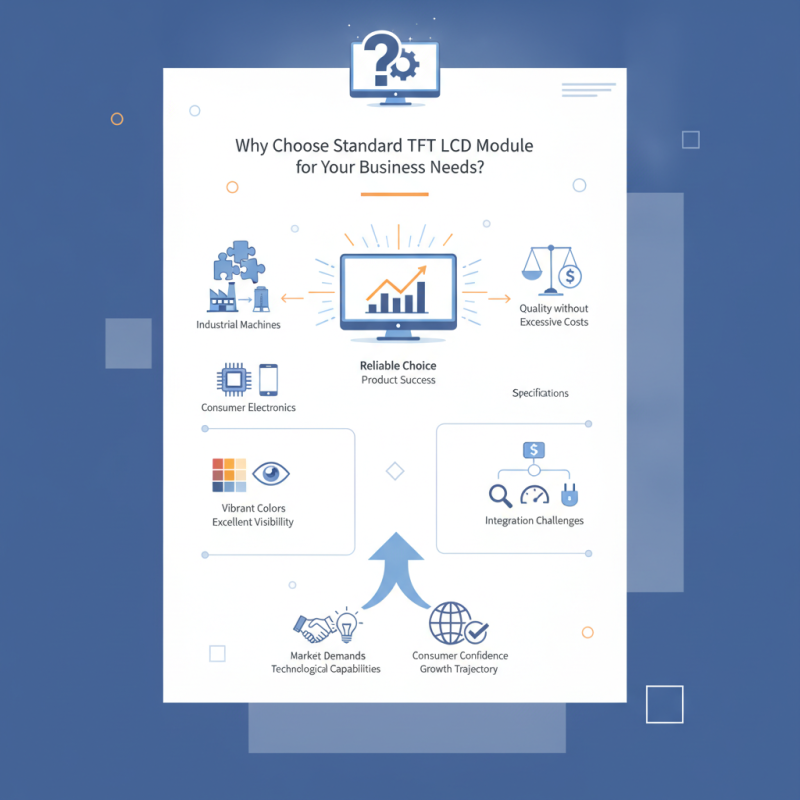
In today's dynamic business landscape, choosing the right display technology can greatly influence your product's success. The Standard TFT LCD Module stands out as a reliable choice for various applications, from industrial machines to consumer electronics. With its vibrant colors and excellent visibility, it attracts attention in a crowded market.
Many businesses grapple with display options, often feeling overwhelmed. A Standard TFT LCD Module presents a balanced solution—offering quality without excessive costs. It is essential to weigh technical specifications, performance, and integration challenges. While this module excels in many areas, careful evaluation of your specific needs is necessary.
Choosing a Standard TFT LCD Module is a strategic decision that reflects understanding market demands and technological capabilities. This module's reliability can boost consumer confidence, but it is vital to remain adaptable. Every business must consider how this technology aligns with its unique vision and growth trajectory.
Understanding TFT LCD Technology and Its Applications
TFT LCD technology has become a cornerstone in various industries due to its versatility. Thin-film transistor liquid crystal displays provide vibrant images and quick response times. This technology is widely utilized in smartphones, laptops, and displays for medical equipment. The color accuracy and resolution are particularly important in professional applications. Users can enjoy improving visuals and detailed graphics.
Understanding the inner workings of TFT LCDs can aid businesses in making informed decisions. These displays consist of multiple layers, including a backlight, liquid crystals, and polarizers. Each layer plays a critical role in image production. While TFT LCDs offer many benefits, they can face challenges such as limited viewing angles and reliance on ambient lighting. Companies need to evaluate their specific needs carefully.
Choosing this technology involves weighing advantages against potential drawbacks. For example, while notable for quality, TFT LCDs may not be the best fit for every scenario. Some setups may require different display technologies for better visibility. Therefore, it’s crucial to assess the environment and user requirements. This reflection ensures that businesses invest in displays that truly enhance their operations.
Comparative Analysis of TFT LCD Module Applications
Benefits of Using Standard TFT LCD Modules in Business
Standard TFT LCD modules offer various benefits that make them suitable for business applications. Their vibrant colors and sharp resolutions enhance visual communication. This is important in retail, where eye-catching displays can attract customers. Additionally, these modules provide a wide viewing angle, ensuring that images remain clear from different perspectives. This is crucial for environments with multiple onlookers, like exhibitions and kiosks.
Reliability is a key factor in choosing these modules. They are generally designed for long-term use, minimizing the need for frequent replacements. This aspect can save businesses money and resources. Moreover, many standard TFT LCDs come with excellent durability against harsh conditions. They can withstand temperature fluctuations and humidity, making them ideal for a variety of settings.
However, not all applications may benefit equally from standard modules. Some businesses require specialized features or customizations that standard options may lack. It's essential to assess specific needs before making a decision. While standard TFT LCDs are a solid choice, the fit depends on individual requirements and conditions. Balancing cost and functionality is a challenge that every business must navigate.
Comparative Analysis: Standard vs. Custom TFT LCD Modules
When it comes to choosing TFT LCD modules, businesses often face a critical decision: standard versus custom. Standard TFT LCD modules are mass-produced, offering a reliable and consistent quality. They come with established specifications, which simplify the integration process. Companies can access them quickly and economically, streamlining their supply chains. This is beneficial for projects with tight budgets and schedules.
On the other hand, custom TFT LCD modules provide tailored solutions for unique requirements. They allow for design flexibility, which can enhance the user experience. However, they typically require longer lead times for production. Custom modules also present risks; the final product may not perform as expected. The potential for unexpected costs can strain budgets. Often, businesses must weigh their immediate needs against long-term goals.
In many cases, the choice boils down to priorities. Standard modules provide a dependable option for everyday applications. Custom modules may fit specialized needs but come with uncertainties. Companies should reflect on their specific requirements before moving forward. A misstep here can lead to costly delays or performance issues.
Factors to Consider When Choosing a TFT LCD Module
When selecting a standard TFT LCD module for your business, several factors must be taken into account. The display's resolution is critical. A higher resolution leads to clearer images. This is vital for applications requiring sharp visuals, such as advertising or medical devices. Consider the viewing angle too. Some modules offer a wider angle, allowing multiple viewers to see the display clearly. Brightness is also essential. A brighter screen works better in ambient light conditions.
Moreover, the module's interface should align with your existing systems. Compatibility can reduce integration challenges. Pay attention to the response time, especially for dynamic content. Slower modules may result in ghosting, a flaw that can impact user experience. It's crucial to evaluate the durability as well. Industrial environments may demand robust modules that can handle extreme conditions.
Don’t ignore power consumption, either. A more efficient module can decrease operational costs over time. Finding a balance between performance and efficiency is vital. While specifications are important, the real-world performance can vary. Testing different options can guide you toward the best choice for your project needs.
Cost-Effectiveness of Standard TFT LCD Modules for Enterprises
When it comes to choosing display technology for businesses, cost-effectiveness is crucial. Standard TFT LCD modules provide a balance of quality and affordability. These modules often require lower initial investments than advanced alternatives. Enterprises can allocate their budget efficiently, focusing more resources on innovation and development.
However, the cost savings do not compromise performance. Standard TFT LCDs offer vibrant colors and reliable image quality. These features are essential for applications like kiosks, monitors, and advertising displays. Yet, businesses must consider if the resolution meets their needs. In some cases, higher resolutions may yield better results, though at increased costs.
Reliability is another important factor. While standard modules are generally dependable, they may not excel in extreme environments. Businesses should assess their operational conditions to ensure compatibility. When making a decision, weighing both the benefits and limitations is vital. The right choice depends on specific business goals and operational demands.