7 Tips for Choosing a Lugged Butterfly Valve?

Selecting the right lugged butterfly valve is a practical decision, not a catalog exercise. The valve must match the medium, pressure, temperature, pipe material, and operating frequency.

Grand View Research estimates that the global industrial valves market will grow at approximately 4.8% annually from 2024 to 2030. This expansion reflects stronger demand for reliable flow-control equipment across water treatment, energy, chemical processing, and manufacturing. The report also highlights efficiency, automation, and lifecycle performance as important purchasing considerations.

Small details matter.

A lugged butterfly valve may look simple, yet its body style, disc clearance, seat compound, and shaft design affect long-term performance. In field inspections, installers often focus on flange alignment but overlook bolt-hole accuracy and nearby pipe obstructions. That mistake can create uneven loading, leakage, or difficult maintenance.

This guide presents seven practical selection tips. It considers pressure class, valve materials, seat compatibility, actuation, standards, installation space, and total ownership cost. API Standard 609 and MSS SP-67 provide useful technical references for butterfly valve design and application. ISO 5752 also supports dimensional and face-to-face evaluation.

However, no report replaces application-specific engineering. Reported market growth does not guarantee suitability for every service. A valve selected for clean water may fail prematurely with abrasive slurry or aggressive chemicals. That difference is easy to underestimate.

Check the operating data carefully. Confirm torque requirements, cycle frequency, isolation needs, and emergency conditions before ordering. A reliable choice should perform predictably today and remain serviceable years later.
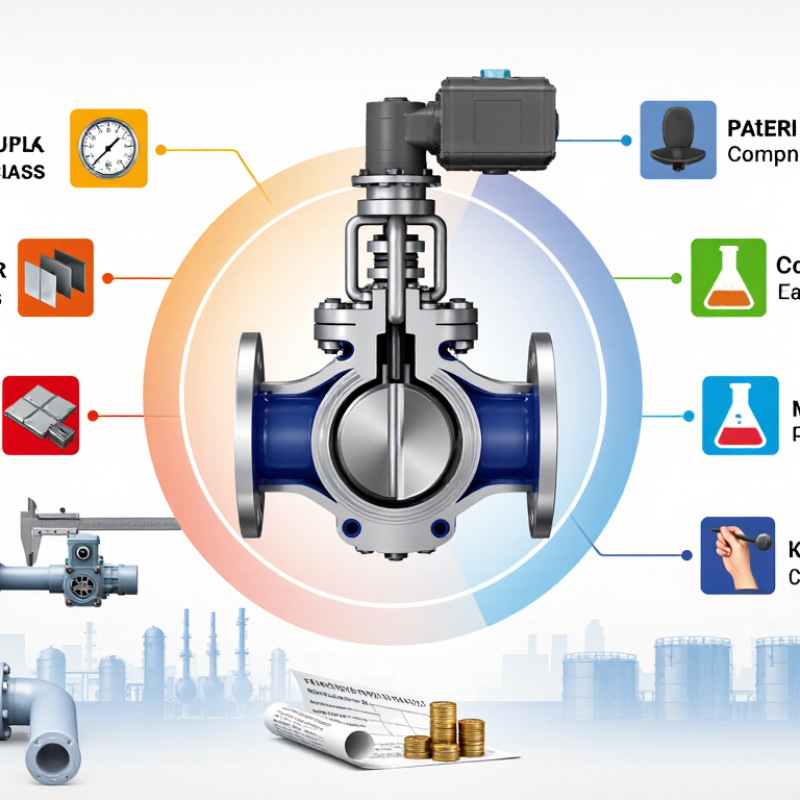
7 Tips for Choosing a Lugged Butterfly Valve?

Define Lugged Butterfly Valves: DN Sizes, 90° Rotation, and Key Standards

A lugged butterfly valve uses a circular disc that turns around a stem. Its quarter-turn motion opens or closes the line through 90 degrees. Unlike a wafer valve, threaded lugs allow independent bolting to each pipe flange. This feature can simplify maintenance on one side. DN sizes indicate nominal diameter, not always the exact internal bore. For example, DN100 describes a nominal 100-millimetre pipeline size.

Tip 1: Match the valve DN with the pipe, flange drilling, and gasket dimensions. Check the pressure class carefully. API 609 commonly covers butterfly valve design requirements, while ASME B16.34 addresses pressure-temperature ratings. ISO 5752 can help confirm face-to-face dimensions. Standards differ by application and edition, so verify the project specification.

Tip 2: Confirm the actual shutoff duty. A lugged valve may support dead-end service, but only when its rating permits it. Do not assume every lugged pattern is suitable for one-sided pressure. Review seat material, fluid temperature, corrosion exposure, and cycling frequency. A valve that feels smooth during a workshop test may behave differently after installation.

Tip 3: Inspect the stem, disc edge, and lug threads before fitting. Keep the disc slightly open during installation to protect the seat. I have seen alignment errors cause premature wear. That detail is easy to underestimate. Allow space for the handle, gearbox, or actuator, and check whether the 90-degree rotation suits the operating position.

Match Seat Materials to Media: EPDM, NBR, PTFE, and Temperature Ratings

Choosing a lugged butterfly valve starts with the fluid, not the pipe size. The seat material must tolerate the media, temperature, pressure, and cleaning routine.

EPDM suits water, glycol solutions, dilute acids, and many alkaline fluids. It performs well with hot water and some steam, but it should not contact oils, fuels, or hydrocarbon-based fluids.

NBR is often a better choice for petroleum oils, lubricants, and fuel-related service. However, it has weaker resistance to ozone, weathering, and certain chemicals. Check the actual temperature range. A typical NBR seat may work around -20°C to 90°C, but the exact limit depends on formulation and pressure.

PTFE handles aggressive chemicals and offers a wide temperature range, often from approximately -40°C to 180°C.

It is not automatically the best option. PTFE can deform under constant compression, especially at elevated temperatures, and may require higher operating torque. That detail is easy to miss.

Do not select a seat from a temperature chart alone. Record normal temperature, startup peaks, cleaning temperature, and pressure together. A valve exposed to 140°C wash cycles needs different consideration than one handling 80°C process water.

I have seen specifications fail because the fluid was compatible at room temperature, but not during cleaning. Confirm the valve’s pressure-temperature rating, seat hardness, shaft sealing, and cycle frequency with verified technical data. Allow a safety margin. Small oversights become expensive leaks.

Verify Pressure Classes: PN10, PN16, and API 609 Performance Requirements

Choosing a lugged butterfly valve starts with its pressure class, not its appearance. Confirm whether the pipeline requires PN10 or PN16. These ratings describe nominal pressure at a reference temperature, not guaranteed pressure under every condition. Temperature can reduce allowable working pressure, especially with soft seats or non-metallic components. Check the manufacturer’s pressure-temperature table.

Review the body, disc, shaft, and seat materials together. A PN16 body does not make every valve component suitable for PN16 service. Verify flange drilling, face-to-face dimensions, and lug-thread specifications. Small mismatches can create serious installation problems. Also confirm whether the valve is approved for dead-end service and the required direction of installation.

API 609 compliance should be checked separately from the PN rating. The documentation should identify the applicable category, design requirements, pressure rating method, and inspection procedures. Ask for pressure-test records, leakage limits, and material certificates. API 609 does not automatically replace project-specific testing requirements. This distinction is often missed.

Be precise here.

Compare the valve’s shutoff performance with the actual medium, temperature, cycling frequency, and line size. A seat that performs well in clean water may behave differently with abrasive slurry or frequent thermal changes. I have seen specifications rely on nominal class alone, then overlook actuator torque and flange loading. That approach needs reconsideration. Reliable selection depends on traceable data, not a pressure label alone.

Select Size and Actuation Using Flow Rate, Cv, and Operating Torque

Choosing a lugged butterfly valve starts with the process, not the pipe diameter alone. Measure the required flow rate, pressure drop, fluid temperature, and specific gravity. A valve that matches the line size may still produce excessive velocity or poor control.

Use the flow data to estimate the required Cv. For liquids, Cv generally rises as flow increases and pressure drop decreases. Check the manufacturer’s published curve at the intended opening, not only at full travel. A valve operating nearly closed can create noise, vibration, and unstable flow. Field measurements are often imperfect, so leave room for uncertain readings.

Actuation depends heavily on operating torque. Include breakaway torque, running torque, seating torque, and the effects of pressure, solids, temperature, and aging seals. Then apply a reasonable safety margin without oversizing the actuator excessively. Too little torque risks incomplete closure. Too much can damage the stem or disc. Manual handles may suit small, accessible lines, while pneumatic or electric actuators support frequent cycling and remote control. Check the lug pattern, face-to-face dimension, shaft orientation, and fail position before ordering. A tidy calculation can still miss installation friction. Review the actual service conditions with a qualified valve engineer.

7 Tips for Choosing a Lugged Butterfly Valve? - Select Size and Actuation Using Flow Rate, Cv, and Operating Torque

Tip Selection Dimension Engineering Rule or Formula Practical Example Recommended Check
1 Confirm the service conditions
Medium, temperature, pressure, and line class
Select body, disc, shaft, and seat materials for the actual fluid and temperature. A lugged valve must also match the pipe flange rating and bolt pattern. For clean water near 20°C, an elastomer-lined valve may be suitable. Hot water, chemicals, abrasive slurry, and hydrocarbons may require different seat and disc materials. Verify maximum working pressure, temperature range, corrosion resistance, flange standard, face-to-face dimension, and pressure class before sizing the actuator.
2 Start with required flow rate
Nominal pipe size is not the same as valve size
For water in US customary units:
Cv = Q ÷ √ΔP
where Q is flow in US gpm and ΔP is pressure drop in psi.
Required flow = 500 US gpm at a 10 psi design pressure drop:
Cv = 500 ÷ √10 ≈ 158.
Use the design flow, minimum flow, maximum flow, and allowable pressure drop. Avoid selecting only by the connected pipe diameter.
3 Choose a suitable Cv range
Use the valve characteristic and operating position
A practical control-valve target is commonly around 60–80% open at normal flow, leaving useful capacity for peak demand without forcing the valve to operate nearly closed. For the 158 Cv requirement, a valve with an available rated Cv of approximately 220–300 may provide a workable normal operating position, subject to the manufacturer’s Cv curve. Check the published Cv at the intended opening angle. Butterfly-valve Cv changes significantly with disc position and is not constant throughout the stroke.
4 Compare nominal size and flow capacity
Illustrative water-service sizing reference
The following values are representative selection ranges for a fully open lugged butterfly valve at approximately 10 psi pressure drop. Actual Cv varies by design, disc profile, seat, and manufacturer.
Nominal Size Representative Cv Approx. Water Flow at 10 psi
DN100 / 4 in80–140250–440 US gpm
DN150 / 6 in180–300570–950 US gpm
DN200 / 8 in350–6001,110–1,900 US gpm
DN250 / 10 in650–1,0002,060–3,160 US gpm
Use the valve’s certified Cv table for final selection. For liquids other than water, correct for specific gravity; for gases, use the appropriate compressible-flow equation.
5 Calculate operating torque
Torque depends on more than valve diameter
Total required torque may include seat breakaway torque, disc-to-seat friction, bearing or packing friction, and hydrodynamic torque. Differential pressure, temperature, fluid solids, and frequency of operation can increase torque. Illustrative clean-water torque ranges for resilient-seated valves:
DN100: 80–150 N·m
DN150: 180–350 N·m
DN200: 350–700 N·m
DN250: 600–1,200 N·m
Obtain separate opening, running, closing, and seating torque values at the maximum differential pressure and worst-case temperature.
6 Size the actuator with a safety margin
Match actuator output to the complete torque curve
A common preliminary approach is:
Required actuator torque ≥ maximum valve torque × 1.25 to 1.50.
Higher margins may be appropriate for severe service or uncertain conditions.
If maximum valve torque is 700 N·m, preliminary actuator output should be at least 875–1,050 N·m, subject to the actuator manufacturer’s output curve and operating mode. For pneumatic actuators, check minimum supply pressure. For electric actuators, check starting torque, running torque, duty cycle, limit switches, and fail-position requirements.
7 Confirm installation and control requirements
Lugged pattern, isolation duty, and throttling duty
A lugged butterfly valve is commonly used for end-of-line isolation because it can be bolted to each flange independently. Confirm whether the valve is rated for dead-end service at the required pressure. For on/off service, use a quarter-turn actuator with open/close limit control. For modulating service, use a modulating actuator and a valve positioner compatible with the required signal. Check flange alignment, bolt length, disc clearance, flow direction if specified, electrical enclosure rating, emergency operation, fail-safe position, and maintenance access.
Engineering note: Cv and torque values shown are representative, non-brand reference data for preliminary selection only. Final valve and actuator sizing should use the certified performance curves for the selected valve design, fluid, temperature, pressure differential, installation orientation, and operating duty.

Check Installation and Maintenance: ISO 5211 Mounting and Leakage Control

7 Tips for Choosing a Lugged Butterfly Valve?

Check Installation and Maintenance: ISO 5211 Mounting and Leakage Control

A lugged butterfly valve should fit the pipeline and the actuator interface. ISO 5211 defines the mounting interface, including flange dimensions and drive components. It does not prove valve tightness. Confirm the actuator torque matches the valve’s breakaway and running torque. Add a sensible margin, but avoid excessive sizing. Oversized actuators can damage the stem or seat.

Leakage control begins before installation. Inspect the disc, seat, and flange faces for scratches or trapped debris. Use the correct bolt sequence and apply even torque. A useful reference is ISO 5208, which establishes pressure-testing procedures and leakage-rate classifications. I would also request documented factory test results, not only a sales statement. That small detail matters.

Environmental impact makes this check more serious. The International Energy Agency’s Global Methane Tracker 2024 estimated 120 million tonnes of methane emissions from fossil-fuel operations in 2023. It also reported that roughly 40% could be reduced using existing measures. Not every butterfly valve handles methane, but poor sealing still wastes product and increases maintenance work. During service, cycle the valve periodically and inspect stem movement, bolts, and actuator alignment. I have seen clean-looking valves fail after careless alignment. The lesson is uncomfortable: installation records may be incomplete, so rechecking remains necessary.

7 Tips for Choosing a Lugged Butterfly Valve: Check Installation and Maintenance

ISO 5211 mounting and leakage control are key considerations when selecting, installing, and maintaining a lugged butterfly valve.

The chart shows nominal bolt-circle diameters associated with common ISO 5211 mounting flange designations. Confirm the actuator mounting pattern, bolt alignment, shaft orientation, gasket condition, and valve-to-pipe centering before commissioning. Leakage testing should follow the applicable project specification and recognized standards such as ISO 5208 or EN 12266-1.

Request a Quote/Further Information

    Download