Choosing a Greenhouse Flower Cart in 2026 requires more than comparing prices and wheel sizes. A suitable cart must match your crop, bench height, aisle width, and daily handling routine. Roses, orchids, and potted chrysanthemums create different transport demands. A cart carrying wet trays may face a very different load than one moving freshly cut stems.
Floriculture economist Dr. Charlie Hall offers a practical purchasing principle: “A cart should earn its place by saving labor, protecting quality, and fitting the workflow.” This idea is especially useful for greenhouse managers. A Greenhouse Flower Cart should roll smoothly over damp concrete, turn safely near crowded benches, and support workers without awkward lifting. Check the frame welds, caster locks, shelf spacing, and maximum load before ordering. Small details matter.
Do not trust impressive specifications alone. A lightweight cart may be easy to push but unstable under tall plants. A heavy steel model may last longer but increase worker fatigue. I have seen buyers overlook doorway clearance, then discover that the cart cannot enter the packing room. That mistake is avoidable. Measure every route first.
This guide examines cart materials, wheel designs, load capacity, corrosion resistance, ergonomics, and maintenance needs. It also considers energy use and long-term operating costs. Some recommendations may not suit every greenhouse. That is the point. The best choice depends on real movement patterns, not marketing language. Test one cart during a busy production day whenever possible. Real work exposes weaknesses quickly.
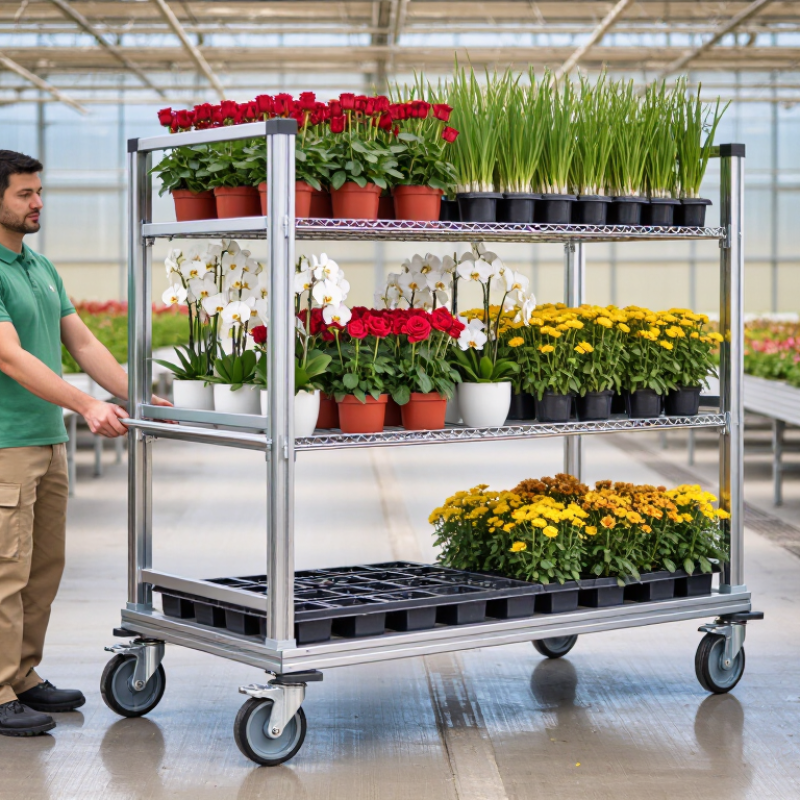
Greenhouse flower carts should match each production stage, not merely the available floor space. For propagation, use narrow carts with two or three adjustable levels. They keep trays close to irrigation points and reduce unnecessary walking. For spacing and finishing, choose rolling bench carts with locking wheels. Their wider decks support mature pots without blocking the main aisle.
Keep it simple.
Harvest workflows need different equipment. A harvest trolley should have a stable frame, smooth casters, and a washable surface. It should turn easily beside dense crop rows. For tall stems, vertical supports prevent bending and bruising during movement. A multi-level rack can help during short-term holding, but poor airflow may damage flowers. That detail is often missed.
The USDA Floriculture Crops 2023 Summary reported approximately 6.7 billion dollars in wholesale value for U.S. floriculture crops. The report does not identify cart demand, but it shows why small workflow delays deserve attention. In my greenhouse planning experience, carts with oversized decks looked efficient on paper. They created awkward turns in practice.
Measure aisle width, crop height, load weight, and cleaning time before purchasing. My first layout was too optimistic. The FAO also emphasizes resource-efficient protected cultivation, making mobility, reuse, and reduced handling relevant design criteria for 2026. Test one cart through watering, spacing, harvesting, and dispatch before expanding the fleet.

2026 How to Choose a Greenhouse Flower Cart?
Compare 250–500 kg Payload Ratings Using EN 1757-1 Safety Criteria
Choosing between a 250 kg and 500 kg flower cart requires more than checking capacity. In greenhouse work, wet floors, narrow aisles, and uneven loads affect safe handling. EN 1757-1 provides useful safety criteria for pedestrian-propelled industrial trucks. However, confirm that its scope matches the cart design and intended use.
A 250 kg cart may suit light flower trays and frequent manual movement. It can reduce pushing effort and improve control in tight rows. A 500 kg cart offers greater capacity, but it needs stronger braking, stable steering, and a carefully designed frame. Check load distribution, wheel condition, platform strength, and visible safety markings. The stated rating should reflect evenly distributed weight, not one heavy stack placed at the edge.
Look for documented testing, operating instructions, and maintenance guidance. Ask how the cart behaves on a damp concrete floor. That detail matters. A practical site trial should include emergency stopping, turning, and loading from different heights. A higher payload is not automatically safer or more efficient. I once viewed larger capacity as the better choice, but aisle congestion changed that judgment. The right decision depends on real routes, worker strength, and daily loading habits. Some specifications still leave important questions unanswered.
2026 How to Choose a Greenhouse Flower Cart?
Choosing a greenhouse flower cart starts with the aisle, not the basket size. Where applicable, ADA guidance commonly uses 915 mm as the minimum clear route width. Local rules and site conditions may differ. Measure the usable passage after adding wheels, handles, plants, and protective rails. Empty-floor measurements can mislead. My first layout looked compliant, but a loaded cart reduced the clear space by several centimeters.
For a 915 mm clear aisle, select a cart narrower than the available operating area. A 700–750 mm body may leave room for steering and small hand movements. Check the widest point, including wheel hubs and corner guards. The cart should move without scraping benches or forcing workers sideways. Keep handles within comfortable reach. Avoid trays that rise above shoulder level. Space matters.
Test it loaded. Use a tape mock-up and mark a 915 mm passage on the floor. Have a worker push, stop, turn, and collect a flower tray. Flowers shift. Wet floors change steering. Larger wheels can cross thresholds more smoothly, but they may increase the cart’s total width. That trade-off deserves review. I once ignored turning space near a door and needed an expensive adjustment. Confirm final dimensions with an accessibility professional or local authority before purchase.
Choose the cart width by adding a minimum 915 mm clear passage beside the cart. The 915 mm dimension equals 36 inches, the minimum clear width commonly specified for an ADA accessible route. These planning values are calculated examples, not manufacturer-specific cart measurements.
Planning rule: Minimum aisle width = flower cart width + 915 mm clear passage. Wider aisles may be needed for turning, loading, equipment, or two-way traffic.
2026 How to Choose a Greenhouse Flower Cart?
In a wet greenhouse, frame corrosion can begin around welds, bolts, and cut edges. Choose aluminum or hot-dip galvanized steel with sealed joints. Stainless fasteners add protection where water collects. Powder coating helps, but it can chip during daily loading. Inspect those damaged spots early. I learned this after a cart developed rust beneath a seemingly sound finish.
PU casters suit greenhouse floors because polyurethane resists moisture and leaves fewer marks than hard metal wheels. Select sealed bearings and a caster diameter suited to gravel, concrete, or uneven paths. Larger wheels roll more smoothly over hose lines and small thresholds. Check the load rating with saturated soil, pots, and tools included. A cart that moves easily when empty may struggle when fully loaded.
Tips: Rinse soil from the frame after use, then let the cart dry. Avoid storing it with water trapped inside tubing. Test swivel locks on a damp floor. They should hold without sudden movement. I would also measure aisle width twice; my first choice was stable, but it blocked a narrow turning point. That small mistake mattered.
| Selection Dimension | Recommended Specification | Why It Matters in a Wet Greenhouse | Practical Check |
|---|---|---|---|
| Frame material | Hot-dip galvanized carbon steel or stainless steel | Moisture, fertilizer residue, and irrigation water accelerate corrosion on untreated steel. | Confirm that all structural parts, including cut edges and weld areas, are protected. |
| Galvanized coating | A continuous zinc coating; heavier coatings generally provide greater corrosion protection. | Zinc protects exposed steel through a barrier effect and sacrificial action. | Request coating classification, coating mass or thickness, and a salt-spray or corrosion test report where required. |
| Stainless-steel option | Use a suitable stainless grade when exposure to fertilizer salts or frequent washing is high. | Stainless steel forms a passive chromium-oxide film that helps resist atmospheric corrosion. | Check the specified grade, surface finish, weld treatment, and compatibility with cleaning chemicals. |
| Frame tube design | Closed rectangular or round tubing with sealed or properly drained ends. | Open tube ends can retain water and fertilizer solution, creating hidden corrosion points. | Inspect drain holes, end caps, welds, corners, and areas where water can collect. |
| Shelf and deck surface | Perforated, slatted, or mesh shelves with smooth, cleanable surfaces. | Open surfaces reduce standing water and improve drainage around flower pots and trays. | Avoid sharp edges, deep joints, and unprotected drilled holes that can trap moisture. |
| Caster tread | Non-marking polyurethane (PU) tread for smooth, damp greenhouse floors. | PU offers good abrasion resistance, quiet rolling, and resistance to water and many common chemicals. | Select the tread hardness and wheel width according to floor condition and cart load. |
| Caster core | Polymer or corrosion-protected metal core; sealed bearings are preferred. | The core and bearing housing are exposed to splash water and may corrode if left unprotected. | Confirm bearing seals, corrosion protection, grease compatibility, and wash-down suitability. |
| Wheel diameter | Approximately 100–150 mm for many manual flower carts; choose larger wheels for thresholds or uneven floors. | Larger wheels generally roll more easily over joints, drainage channels, and minor floor irregularities. | Measure the narrowest aisle, doorway clearance, floor gaps, and required cart height. |
| Load capacity | Rated capacity should exceed the total operating load, not only the empty-cart weight. | Wet soil, pots, water, and uneven loading can substantially increase the working load. | Use: required capacity per caster = total loaded weight ÷ 3, allowing one caster to carry less on uneven floors. |
| Swivel and brake system | Two or four swivel casters, with total-lock or directional-lock brakes as needed. | A brake helps prevent movement on sloped or wet floors during watering and plant handling. | Test steering, brake engagement, swivel clearance, and access while the cart is fully loaded. |
| Floor protection | Non-marking PU wheels with a smooth tread profile appropriate for the floor coating. | The correct tread reduces black marks, concentrated point loading, and damage to sealed concrete or resin floors. | Check wheel pressure, hardness, tread condition, and the floor manufacturer's recommendations. |
| Cleaning and maintenance | Wash off fertilizer residue, remove plant debris, dry standing water, and inspect casters regularly. | Routine cleaning limits chemical deposits and helps reveal early coating damage or bearing problems. | Create an inspection schedule based on irrigation frequency, wash-down practice, and operating hours. |
Note: Final frame size, shelf spacing, caster rating, wheel diameter, and brake configuration should be selected from the cart's fully loaded weight, aisle width, floor condition, and greenhouse cleaning procedures.
Brake safety deserves equal attention to load capacity. ISO 11228-1:2021 does not offer one universal weight limit. It requires assessment of posture, force, distance, frequency, and working conditions. NIOSH’s Revised Lifting Equation uses a 23-kilogram load constant under ideal conditions. Treat that figure as a screening reference, not a purchasing target. Wet floors, narrow aisles, and repeated turns reduce practical capacity. A wet aisle changes everything.
Test the cart fully loaded on the steepest greenhouse route. Check whether the parking brake holds without creeping. Inspect wheel locks, handle height, turning resistance, and visibility around flower stems. The UK HSE RAPP tool evaluates pushing and pulling risks through force, posture, travel distance, and frequency. An adjustable handle near waist height may reduce shoulder strain, but it cannot correct badly aligned wheels. Small wheels often struggle over drainage channels. That detail is easy to miss.
Total cost includes purchase price, wheel replacement, brake servicing, charging, cleaning, and downtime. Liberty Mutual’s 2024 Workplace Safety Index estimated serious workplace injuries cost U.S. employers 58.5 billion dollars, showing why labor risk belongs in the calculation. Compare maintenance records over three years, not only the invoice. My first estimate might still be too optimistic. A cart that costs less but needs two workers can become expensive quickly.
© Shipham Valves 2025. All Rights Reserved.
Website By PS Website Design Ltd
Request a Quote/Further Information
Download
We use cookies on this website, by continuing to browse the site you are agreeing to our use of cookies. Find out more.